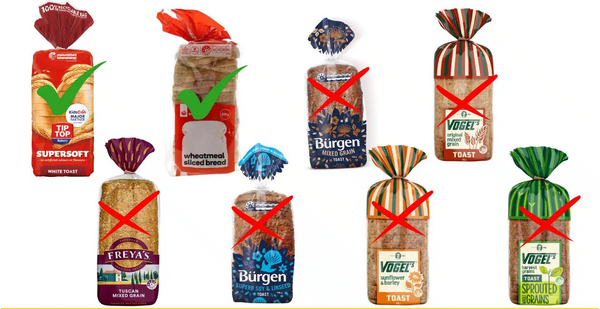
Why is folic acid added to bread in New Zealand?
Folic acid is added to bread in New Zealand to reduce the risk of neural tube defects in newborns. It’s a public health fortification policy that aims to improve population folate levels, though some people debate whether universal addition is the best approach.

This started as a practical problem, not a political one.
I wasn’t trying to make a statement about food or health. I was simply trying to work out how to avoid something I hadn’t consciously chosen to consume — and discovered that it wasn’t easy.
That led me to a much bigger question:
Why is folic acid added to bread in New Zealand, and what does that mean for the rest of us who eat it every day?
I don’t have a definitive answer yet. What follows is my attempt to understand the reasoning, the benefits, and the uncertainties well enough to make my own informed decision.
What is folic acid?
Folic acid is the synthetic form of folate, also known as vitamin B9.
Folate is an essential nutrient. It plays a role in DNA synthesis, cell division, and the formation of red blood cells.
It is especially important during early pregnancy, where adequate folate levels are linked to a reduced risk of neural tube defects in developing babies.
Folate occurs naturally in foods like leafy greens, legumes, whole grains, nuts, seeds, and organ meats.
Folic acid, however, does not occur naturally in food. It is manufactured and used in supplements and food fortification because it is stable, cheap, and easy to add consistently to products like flour.

Why add folic acid to bread?
The public health reasoning is fairly straightforward.
Neural tube defects occur very early in pregnancy — often before someone knows they are pregnant. Because many pregnancies are unplanned, relying on supplementation alone doesn’t reliably reach everyone who might benefit.
Bread is eaten by a large proportion of the population, across income levels and dietary patterns.
Adding folic acid to bread is seen as a way to ensure a baseline intake across the population, particularly for women of childbearing age.
From a policy perspective, the intention is preventative: reduce the risk of serious birth defects by ensuring consistent folate intake.
Why is it mandated rather than optional?
New Zealand previously relied on voluntary fortification, where manufacturers could choose whether or not to add folic acid.
Over time, health authorities concluded that voluntary approaches did not achieve sufficient coverage, particularly among groups considered most at risk.
Mandatory fortification was seen as a way to ensure consistency and equity — reaching people regardless of diet, income, or access to supplements.
This is where the government becomes involved in individual nutrition decisions — not to manage personal diets, but to operate at a population-health level rather than an individual one.
That distinction matters, even if it doesn’t resolve everyone’s discomfort.
Why some people feel uneasy about it
This is where things become less clear-cut.
Mandatory fortification means everyone consumes folic acid, not just those who are planning pregnancy or who are known to benefit most.
Some of the questions that come up include:
- What happens when people consume synthetic folic acid long-term?
- Do all bodies metabolise folic acid efficiently?
- What about people who already get sufficient folate from whole foods?
- Is there a meaningful difference between naturally occurring folate and synthetic folic acid?
There is discussion in the scientific literature about unmetabolised folic acid appearing in the bloodstream when intake exceeds what the body can process at once.
What that means in practical, long-term terms is still debated.
Uncertainty does not automatically mean harm — but it does raise reasonable questions about dosage, duration, and individual variation.
How much folate do we actually need?
Nutrient requirements vary by age, sex, and life stage.
Pregnancy significantly increases folate requirements.
For others, recommended intake levels are lower and are often achievable through a diet that includes a variety of whole foods.
One complexity is that synthetic folic acid and natural folate are measured differently, because the body absorbs them differently.
This can make it difficult for individuals to know how much they are actually consuming — particularly when fortification is universal rather than optional.
Where can folate be found naturally?
Folate occurs naturally in many foods, including:
- leafy green vegetables
- legumes (lentils, beans, chickpeas)
- whole grains
- nuts and seeds
- liver
Diets built around minimally processed foods often contain meaningful amounts of natural folate without supplementation.
This doesn’t negate the rationale for fortification, but it does raise the question of whether a single, population-wide approach suits everyone equally well.
Is folic acid “natural”?
Folic acid is synthetically produced. It does not exist naturally in food.
That doesn’t automatically make it harmful.
Many synthetic nutrients are used safely and effectively. However, synthetic does not always mean identical in biological behaviour.
Folic acid is chosen for fortification because it is stable and predictable — not because it perfectly mirrors natural folate.
Understanding that distinction helped me think about the issue more clearly, without needing to take a strong position either way.
What foods must have folic acid added in New Zealand?
Under current regulations, folic acid must be added to most standard bread products.
There are exemptions, but in practice this means that opting out is difficult — particularly if you rely on supermarket bread.
This was the moment where the issue stopped being abstract for me and became personal.
I wasn’t trying to avoid bread. I was trying to avoid a specific additive — and discovered that the choice had effectively been removed.

What does it cost, and who pays?
At the level of a single loaf, the cost of fortification is very small.
At a population level, the cost is justified through projected healthcare savings and reduced burden associated with neural tube defects.
This is a classic public health trade-off:
- small individual cost
- large collective benefit
Whether that trade-off feels acceptable depends on how much weight you place on choice, uncertainty, and individual variation.
Where I’ve landed (for now)
I don’t think this is a settled conversation.
I can understand the public health reasoning behind mandatory folic acid fortification, and I don’t doubt the intention is to reduce harm.
At the same time, I’m uncomfortable with how little space there seems to be for nuance, individual choice, or ongoing questioning — especially when the intervention applies to everyone, every day.
For now, I’ve chosen to minimise my exposure by changing what I eat, rather than expecting the system to change around me.
That decision isn’t a judgement on others — it’s simply where I feel most comfortable while the questions remain open.
This note isn’t meant to persuade. It’s meant to document a line of inquiry.
If nothing else, it reminded me that asking calm questions is not the same as rejecting science — it’s part of how understanding evolves.
I’ll keep learning.