Non-Animal Rennet in Cheese
Most non-animal rennet used in cheese today is made by large international ingredient companies such as DSM, Chr. Hansen, IFF and Novozymes. These firms supply the enzymes to cheese makers around the world, replacing traditional calf-derived rennet.
The Invisible Ingredient Behind Modern Cheese
Cheese feels like one of the oldest foods we eat.
Milk, cultures, salt and time.
But the step that actually turns milk into cheese depends on a very specific enzyme: chymosin.
Traditionally this came from the stomach of young ruminants and was known as animal rennet.
Today, most cheese no longer uses it.
Around 80–90% of commercial cheese is made using a laboratory-produced version called fermentation-produced chymosin (FPC), often described on labels simply as non-animal rennet.
What Rennet Actually Does
Milk does not naturally form a solid curd.
The main milk protein, casein, must be cut at one precise location.
Chymosin performs that cut.
Once this happens:
milk → curds + whey
Without this step, cheddar, gouda, brie and parmesan would not exist.
The Shift From Biological Supply to Industrial Supply
Traditional rennet had limits.
It depended on livestock production and natural biological cycles.
In the late 1980s biotechnology companies developed a new method: inserting the calf chymosin gene into microorganisms so they could produce the enzyme during fermentation. The process was commercialised globally through pharmaceutical and biotech partnerships, including large-scale licensing and distribution by Pfizer.
The enzyme could now be manufactured continuously rather than sourced from animals.
No seasonal supply limits.
No dependence on slaughter by-products.
Unlimited global production.
This single change allowed cheese to become a continuous industrial product rather than a biologically constrained one.
Why It Was Adopted So Quickly
The change was not driven by safety concerns.
It solved manufacturing problems:
- predictable coagulation
- higher yields
- consistent texture
- large-scale production
- lower cost
In short, it allowed cheese to be standardised.
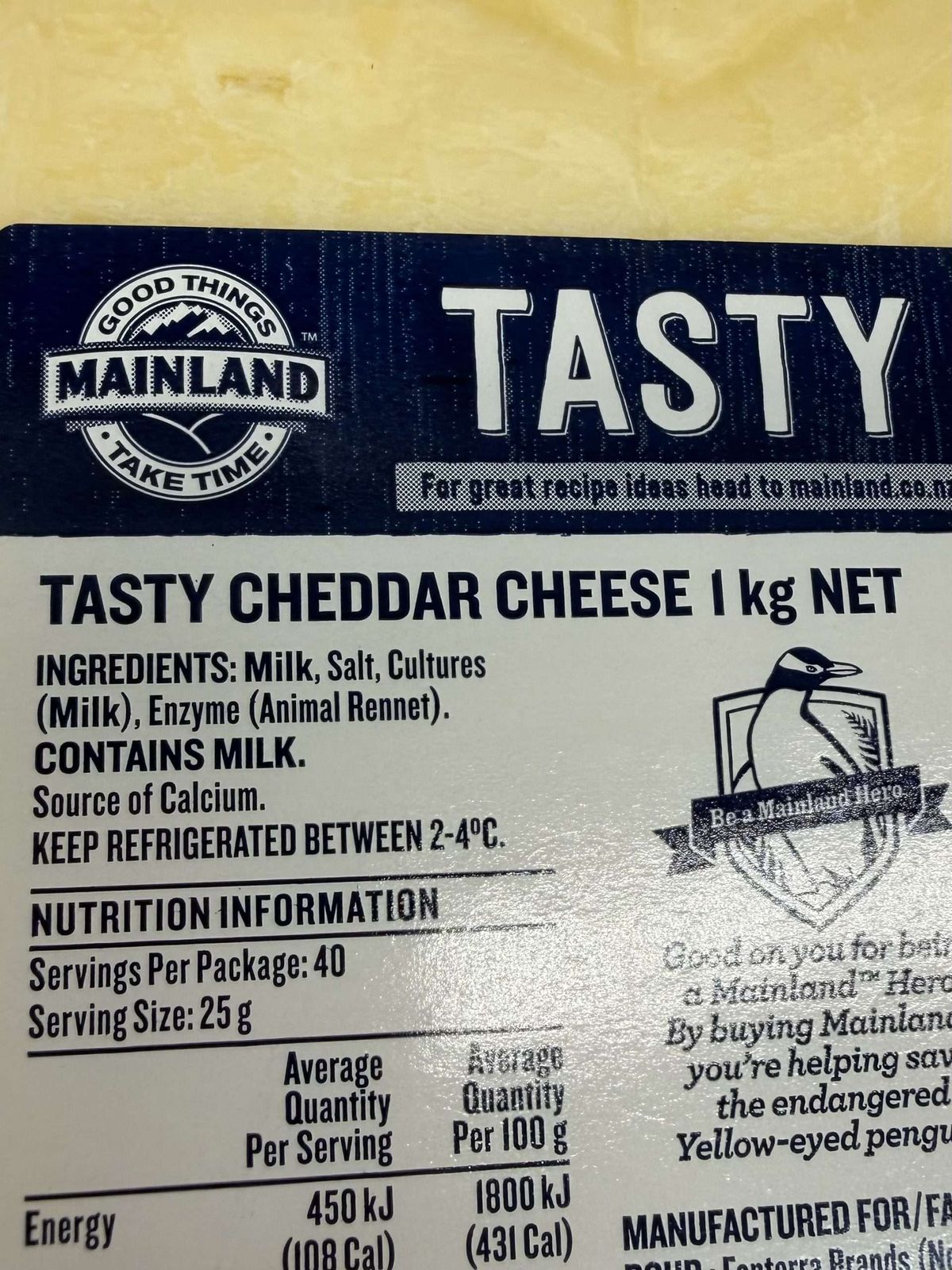
How It Appears on Labels (New Zealand)
In New Zealand ingredient lists usually describe it as:
“non-animal rennet” or simply “enzymes.”
Because it is considered a processing aid rather than a primary ingredient, detailed disclosure is rarely required. The cheese contains the purified enzyme, not the microorganism that produced it.
This means a modern biotechnological process can exist inside a food that otherwise appears entirely traditional.
Safety Classification and Long-Term Evidence
Regulators classify fermentation-produced chymosin as GRAS (Generally Recognized As Safe) because:
- the enzyme molecule is identical to calf chymosin
- it is digested like dietary protein
- no direct toxic effects have been demonstrated
After more than three decades of use there is no evidence of harm.
However, like many processing aids, approval was based on biochemical equivalence rather than long-term population dietary studies, largely because enzymes are broken down during digestion and do not remain biologically active in the body.
So the discussion around it is less medical and more about food systems and transparency.
Flavour, Texture and Ageing
Animal rennet is not a single purified enzyme.
It contains supporting enzymes that continue breaking down proteins and fats during maturation.
These reactions contribute to complexity in long-aged cheeses.
Fermentation-produced chymosin is highly purified and consistent.
This produces reliable texture and mild flavour development, ideal for large-scale production.
For everyday cheese the difference is often small.
For aged cheeses it can influence depth and character, which is why some traditional cheeses still require animal rennet.
Transparency and Trust
For many years this change happened quietly inside manufacturing.
Recently, wider public discussion has begun to notice it.
Recent viral scrutiny (e.g., 2026 Pfizer-linked backlash) highlights how invisible ingredients can erode trust when not clearly disclosed.
The issue is rarely about immediate safety.
It is about understanding how food is made.
What Actually Changed About Cheese
Traditional cheese:
linked to farming cycles, limited supply, natural variation.
Modern cheese:
linked to industrial fermentation, continuous supply, standardised outcome.
Fermentation-produced rennet did not make cheese unsafe.
It made cheese scalable.
And most of the time, it did so without consumers realising the change had happened.